If a drain keeps blocking even after it has been cleared properly, the pipe itself may be the problem. Pitch-fibre drains were fitted in many post-war homes, and their walls can soften, blister, and lose their round shape as they age. The right pitch fibre pipe repair depends on how far that change has gone. A CCTV drain survey is the starting point because it shows whether the pipe can be reshaped and relined or whether a collapsed section needs to be replaced.
What is pitch-fibre pipe?
Pitch-fibre is a lightweight pipe made from wood cellulose fibre impregnated with coal-tar pitch. It became a practical choice for underground drainage during the post-war building period because it was light to carry, quick to cut, and cheaper to install than heavier clay or concrete sections. It appears in homes built or altered during the 1950s, 1960s, and early 1970s, although the age of a property does not prove what lies underground.
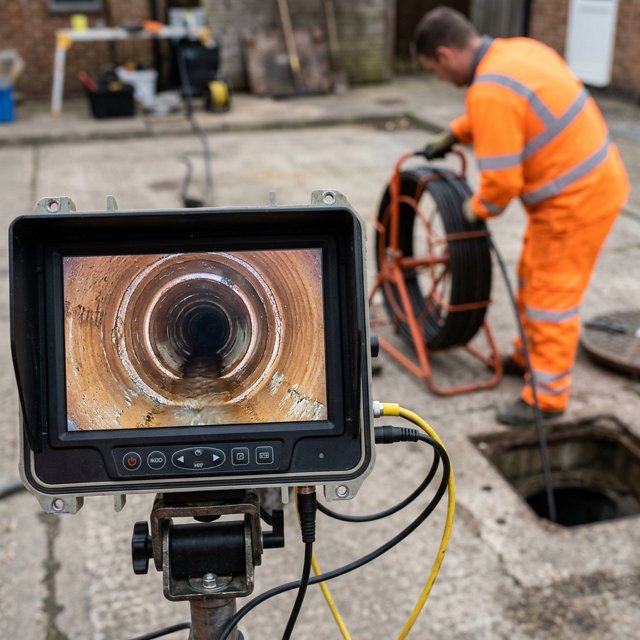
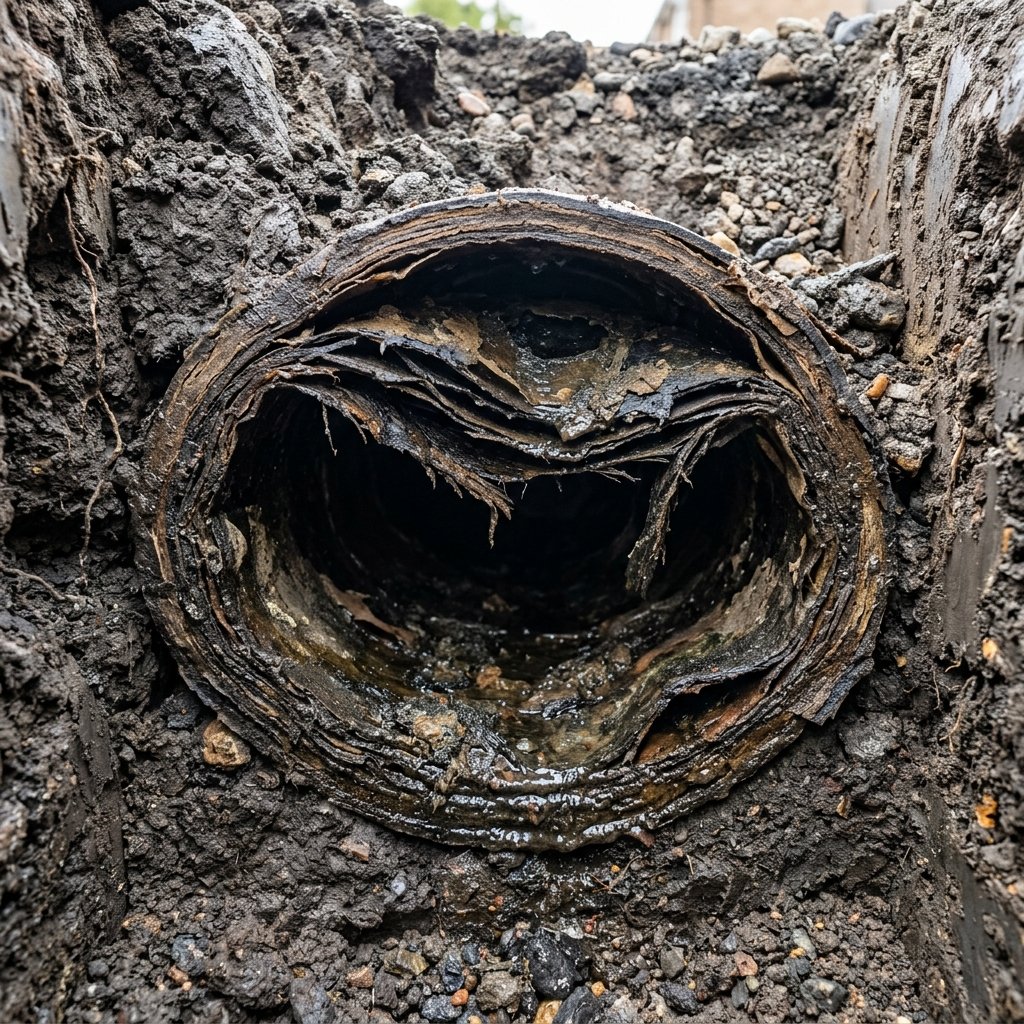
A sound section normally looks black or very dark brown. At a broken edge, the wall can show visible layers rather than the solid edge seen on plastic. A CCTV image may show a smooth bore at first, followed by ripples, bubbles, or a flattened section. That change of shape is one of the clearest pitch fibre drain problems.
Post-war areas such as Tile Hill, Canley, and Walsgrave may contain pitch-fibre, clay, concrete, and later plastic within the same neighbourhood. These local pages explain the property and access patterns, but none assumes the pipe material from the postcode alone.
The same caution applies across the Black Country. Post-war building and later alterations mean homes in Brownhills and Bloxwich can have more than one pipe material along a single route. Around Oldbury, residential drains may also cross former industrial ground or connect through altered yards. We confirm the material on camera before discussing reshaping, lining or excavation.
That distinction is useful in Webheath drainage, where older settlement and later suburban housing meet. Our local page explains why we inspect the actual material, extension junctions and retained garden routes before a structural repair is proposed. Being in a Redditch postcode is a reason to ask about the buried pipe, rather than proof that it contains deformed pitch-fibre.
Why pitch-fibre drains fail
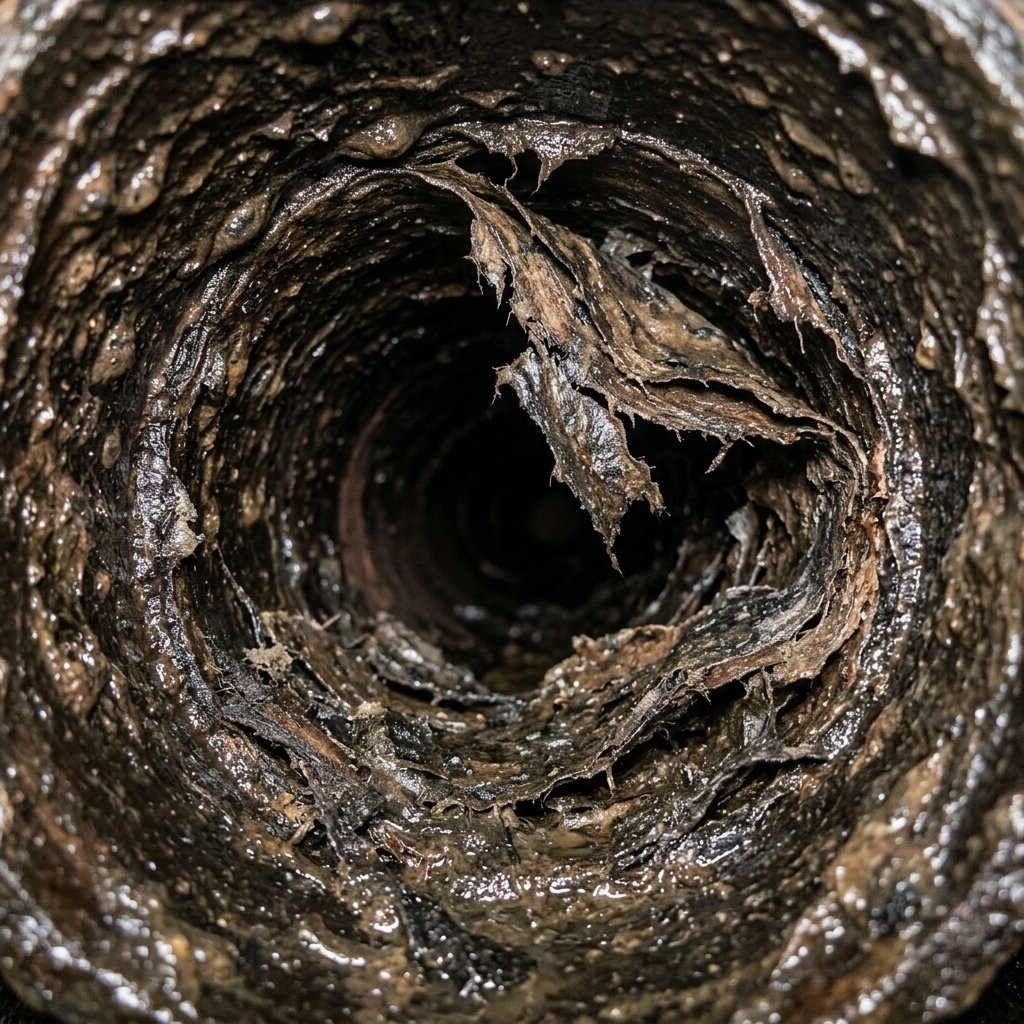
Pitch-fibre behaves differently from rigid clay or PVC. Years of ground pressure and loading from above can squeeze the pipe into an oval shape. The inner wall can also separate into layers and form blisters. Toilet paper and waste catch on those raised areas, so a blockage returns even when the line was recently jetted.
Hot discharges, oils, and strong chemicals may contribute to deterioration. Tree roots can exploit a weak joint or damaged connection, while poor support beneath a pipe can leave a low point that holds water. More than one fault may be present, which is why clearing the immediate blockage is not the same as fixing its cause.
Pitch-fibre pipe life expectancy
You may see a fixed pitch fibre pipes life expectancy quoted online, but age alone is a poor test. Two pipes installed in the same year can be in very different condition. Depth, soil movement, vehicle loading, installation quality, and what has passed through the drain all matter. Many surviving installations are now several decades old, so recurring symptoms deserve investigation, but replacement is not automatic.
A camera survey records the pipe shape, joint condition, deposits, and any point where the lens cannot pass. The footage also helps separate a structural fault from grease, scale, roots, or a simple soft blockage. Our comparison of drain relining and excavation explains how an internal sleeve repairs suitable faults without lifting the surface above.
What useful CCTV evidence looks like
A useful survey does more than name the pipe material. The operator should clean the line first, record the route from a known access point, and note the distance to each defect. If a report says only "pitch-fibre present" without showing how much the bore has narrowed, it does not give enough information to price a repair.
We look at whether the camera head stays level, whether water is sitting in a low section, and whether the wall springs back after careful reshaping. A local blister may suit a short repair. A long run that has become oval may need full-length lining. If the camera stops at a crushed section, a second access point can help confirm how much pipe is affected before anyone starts digging.
Can a pitch-fibre drain be repaired without digging?
A no-dig pitch fibre repair is possible when the line can be opened to a workable shape and retains enough structure to support a resin liner. The pipe is cleaned, mechanically reshaped where appropriate, measured, and lined from an access chamber. Once cured, the liner forms a smooth pipe inside the old one and removes the raised edges that were catching waste.
Relining is not suitable for every case. If soil has entered through a full collapse, a section has moved badly out of line, or the bore cannot be restored, the damaged length may need targeted drain repair by excavation. A reputable recommendation should be tied to camera evidence rather than the age of the house.
What to do if you suspect pitch-fibre
- Keep a note of repeat faults. Record which fittings slow down, when the drain was last cleared, and how quickly the problem returned.
- Avoid repeated chemical treatments. They will not restore a flattened pipe or remove an internal blister.
- Clear the line before surveying it. The camera needs a clean view of the pipe wall.
- Ask to see the footage. Look for a loss of shape, rippled walls, trapped water, and the point where waste catches.
- Compare repair options. The report should state why relining, a local patch, or excavation is suitable.
Drainage can also be overlooked in newer homes. Our case study on an independent CCTV survey for a new-build property shows why pipe condition and connections should be checked rather than assumed.
Pitch-fibre drains around south Birmingham
Post-war extensions and housing mean pitch-fibre can turn up across our service area. We inspect recurring faults through our drainage service in Rubery, drain unblocking in Rednal, and drainage work in Frankley, as well as Coventry and the wider West Midlands. Every diagnosis starts with what is actually visible in the pipe.
Questions about pitch-fibre drains
What does a pitch-fibre drain pipe look like?
It is usually black or dark brown, with a layered, fibrous edge where cut or broken. On camera, damage may appear as an oval bore, rippled wall, raised blister, or fold projecting into the flow. It is the change in shape along the run, rather than the colour alone, that often gives the clearest clue.
How long do pitch-fibre pipes last?
There is no reliable expiry date. Installation, loading, ground movement, heat, and chemical exposure all affect condition. One old section can remain serviceable while the next has flattened, so we would not recommend replacement from the house age alone.
Can pitch-fibre drains be repaired without digging?
Often, yes. A pipe that can be reshaped and still supports a liner may be repaired from existing access points. It must be cleaned, opened to a workable bore, and measured before the liner is made. A full collapse or serious displacement may still need a small excavation.
What are the signs of pitch-fibre drain failure?
Repeat blockages, slow flow, gurgling, internal blisters, and a visibly flattened bore are common signs. The drain may behave normally for a while after jetting because the trapped waste has gone, then block again at the same point. CCTV footage is needed to distinguish deformation from roots, grease, or a damaged joint.
Will Severn Trent replace a pitch-fibre drain?
Responsibility follows the drain layout, not its material. You normally deal with a private pipe that serves only your property. If the defective section is shared with another property or forms part of the public sewer network, give Severn Trent the location and any survey evidence so it can assess the report.
Concerned About a Pitch-Fibre Drain?
We can clear the line, inspect it by camera, show you the fault, and explain whether relining or a targeted replacement is the sensible repair. Fixed pricing and no call-out fee.
Call: 0121 296 7829